Inspections due?
We come to the yard.Mobile DOT and BIT inspections in Orange County
90-day BIT inspections and DOT compliance work done where your trucks are parked — on your schedule, with the paperwork kept so a CHP terminal inspection finds consecutive records instead of gaps.
What the 90-day actually covers
California requires motor carriers running regulated vehicles to have them inspected at least every 90 days — more often if that's what safe operation takes. The Vehicle Code spells out five areas the inspection has to cover at a minimum:
- Brake adjustment
- Brake system components & leaks
- Steering & suspension systems
- Tires & wheels
- Vehicle connecting devices
That's the floor, not the ceiling. In practice a walk that stops at those five and ignores lights, air system, wheel ends and leaks is how a truck passes a 90-day in the yard and gets tagged two weeks later at the scales. We do the whole vehicle.
One that catches people: a truck parked longer than 90 days doesn't need inspecting on the cycle while it sits — but it does need inspecting before it goes back on the highway. An idle truck can't just be fired up and dispatched.
The records, not the wrenching
Carriers have to keep these inspection records at the terminal for two years and hand them to any authorized CHP employee who asks. That's the part that goes wrong. The trucks are usually fine. The folder is what has holes in it.
Gaps in the sequence
A truck bought mid-year, a truck that sat, a truck somebody else serviced once. The inspections happened but the paper trail skips. An auditor reads the gap, not the intention.
Records nobody can find
Kept in a glovebox, on a phone, or with a shop that's since closed. If it isn't at the terminal when CHP asks, functionally it doesn't exist.
Paperwork that says nothing
A signature and a date with no itemized findings. A record that doesn't show what was inspected is hard to stand behind when someone is checking whether the inspection really happened.
Every inspection we do comes back as an itemized record with the date, the unit, what was checked, what was found and what was corrected — in a form you can hand straight to an inspector.
Terminal inspection scheduled and the folder's thin?
Call before it happens, not after. We can get the fleet walked, get current inspections on record, and get the obvious findings corrected while there's still time to do it in order. Already failed one? Here's the way back into service.

Thirty years of
compliance work
RES Heavy is Russell Schwartz — master diesel technician, 30+ years, factory trained by Caterpillar, Cummins and Isuzu.
Years of DOT and CHP compliance work, including CHP compliance repairs for commercial fleets, and support for operations like Penske and South Coast Water District. Knowing what an inspector measures and what he needs to see is the difference between an inspection and a piece of paper.
And if the walk turns up a problem, it gets fixed on the same visit. No second appointment, no sending the truck somewhere else.
Call or text (949) 254-4518.
90-day BIT inspection questions
What is a 90-day BIT inspection and who needs one in California?
A 90-day BIT inspection is California's own inspection cycle, on top of anything federal: motor carriers operating regulated vehicles in the state have to get each one inspected at least every 90 days, or more often if that's what safe operation takes. It comes out of the CHP's Basic Inspection of Terminals program — BIT — and it's the cycle a terminal audit measures your folder against. Broadly, if you run trucks commercially in California, assume the program applies to you and your trailers; exactly which vehicles are covered depends on how they're classified and what they haul or tow. When in doubt, ask the CHP — or call and we'll talk through your fleet.
What does a BIT inspection cover?
The Vehicle Code names five areas as the minimum: brake adjustment, brake system components and leaks, steering and suspension systems, tires and wheels, and vehicle connecting devices. A walk that stops there still leaves a truck that can get tagged at the scales, so ours covers the whole vehicle — the air system charged and listened to, lighting, wheel ends, and the frame and crossmembers along with those five. Anything out — a brake past its adjustment limit, a lamp dead, a cracked spring hanger — goes on the itemized record, and most findings get fixed on the same visit. You get a record that shows what was checked and what was found, not just a signature and a date.
How long do I have to keep BIT inspection records?
Two years. The California Vehicle Code requires a motor carrier to retain these inspection records at its terminal and make them available to any authorized CHP employee on request. Missing or non-consecutive records are one of the most common problems a terminal inspection turns up.
Does a truck that has been parked still need a 90-day inspection?
A vehicle out of service for more than 90 calendar days does not have to be inspected on the 90-day cycle while it sits, but it must be inspected before it goes back on the highway. In practice that means an idle truck cannot simply be started up and dispatched.
Can a mobile BIT inspection be done at my yard?
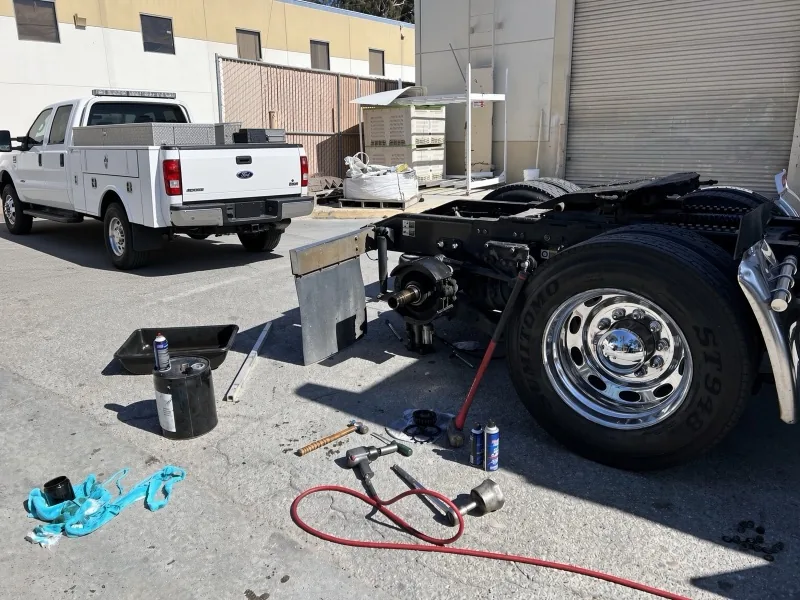
Yes — mobile is the whole point. RES Heavy inspects the fleet where it's parked, on your schedule, so trucks aren't sent out one at a time to sit at a shop while the yard falls behind. One truck or twenty, tractors and trailers both, and the records come back itemized and ready for the folder. Call (949) 254-4518.
What's the difference between a BIT inspection and the annual DOT inspection?
They're different programs on different clocks. The 90-day BIT inspection is California's cycle, run through the CHP, and it's what a terminal audit measures your records against. The annual DOT inspection is the federal FMCSA periodic inspection — once every 12 months, against the federal Appendix G checklist, with its own paperwork and inspector-qualification rules. There's a lot of overlap in what gets checked, and a truck kept honest on a 90-day cycle is rarely surprised by the annual. We do both at the yard, and the same visit can keep both sets of paperwork current.
Which vehicles fall under these rules depends on how they're classified, what they tow, and what they haul, and the Vehicle Code has been amended in recent years. This page describes the requirements in general terms — for whether a specific truck in your fleet is covered, check with the CHP or read the current Vehicle Code §34501.12. Happy to talk it through on the phone.
Mobile BIT inspection, any size fleet
One truck or twenty. Set the interval, we show up, the paperwork stays current.