The 90-day checklist.
Trucks and trailers.California 90-day BIT inspection checklist
See the separate truck and trailer checklists, the five required inspection areas, and what goes on the inspection record.
The five required inspection areas
California's 90-day inspection has to cover these five at a minimum, on every regulated vehicle, at least every 90 days. The headings are the statute's. The detail under each one is what we check.
Brake adjustment
Pushrod stroke measured at every wheel position with the brakes applied, against the limit for that chamber. Measured, not felt from the seat. Automatic slack adjusters get checked for actually adjusting, because a seized one looks fine from outside.
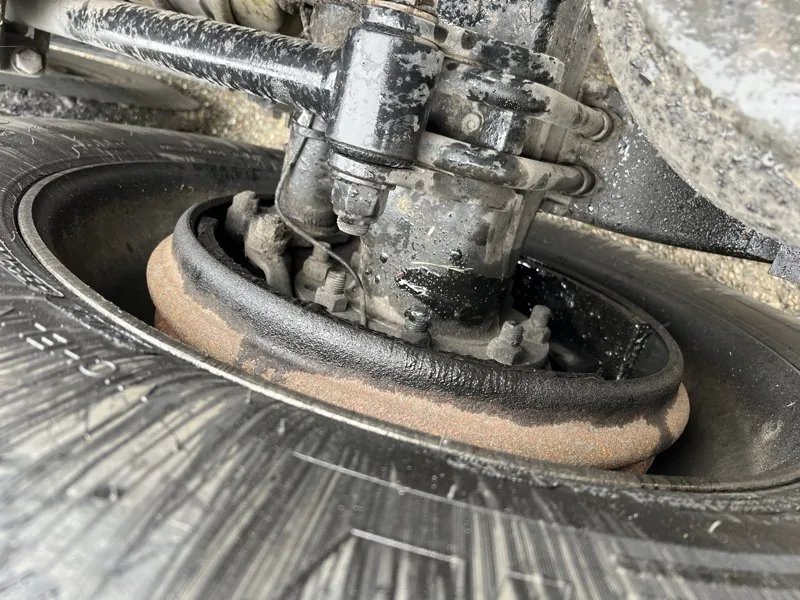
Brake system components and leaks
Chambers, slack adjusters, S-cams, hoses and lines, drums and linings. Then the air system charged and listened to with the brakes applied and released, because some leaks only show under application.
Steering and suspension systems
Play at the wheel, the steering gear and its mounting, pitman arm, drag link and tie rod ends. Then springs, hangers, U-bolts, torque rods and air bags, looking for cracks, shifted leaves and loose or missing fasteners.
Tires and wheels
Tread depth, sidewalls and inflation at every position, duals matched and not touching. Wheels and rims checked for cracks, lug nuts and studs for looseness, and hubs for a leaking seal.
Vehicle connecting devices
Fifth wheel mounting, jaws and release on the tractor. Kingpin and upper coupler on the trailer. Pintle hooks, drawbars and safety chains on anything pulled behind a truck.
90-day inspection checklists
Truck and trailer inspections use separate checklists and records. Jump to the trailer checklist.
Truck checklist
- Fire extinguisher and reflective warning devices
- Horn, defroster, gauges, odometer, and speedometer
- Mirrors and supports
- Windshield wipers, window cracks
- All lights, signals, reflectors, mudflaps
- Electrical wiring-condition and protection
- Batteries, corrosion, water level, terminals, cables, hold downs
- Warning devices-air, oil, temperature, anti skid, and/or vacuum
- Radiator and water hoses-coolant level, condition, and/or leaks
- Belts-compressor, fan, water pump, and/or alternator
- Air hoses and tubing leaks, condition, and/or protection
- Fuel system-tanks, hoses, tubing, and/or pump, leaks
- Exhaust system, manifolds, piping, muffler, leaks and condition
- Engine-mounting, excessive grease and/or oil
- Clutch adjustment-free play
- Air filter, throttle linkage
- Starting and charging system
- Tractor protection valve
- Hydraulic brake system-adjustment, components and condition
- Hydraulic master cylinder leaks, and condition
- Hoses and tubing-condition and protection
- Air brake system-adjustment, components, and condition
- 1 minute air or vacuum loss test
- Air compressor governor cut-in and cut-out pressures (85-130)
- Primary air tank-drain and test check valve
- Other air tank-drain and check for contamination, securement
- Tires-tread depth, inflation, mis-match, and condition
- Wheels, lug nuts, studs, cracks, loosens, and condition
- Parking brake able to hold the vehicle
- Emergency stopping system labeled and operative
- Brakes set after air loss below 30psi
- Steering system-mounting, free lash, and components
- Steering arms, drag links, and tie rod ends
- Connecting devices-fifth wheel, pintle hitch, and safety devices
- Suspension system-springs, shackles, u-bolts, and torque rods
- Frame and cross members-cracks and condition
- Drive shaft, universal joints, and guards
- Transmission and differential-mounting, leaks and condition
- Wheel seals-leaks and condition
- Under carriage-clean and secure
Trailer checklist
- Trailer tires: tread in thirty-seconds, inflation, no flat-spotting.
- Trailer wheels, rims, lugs, and hub oilers.
- Trailer brakes: linings, stroke, hoses.
- Trailer suspension and slider: pins locked.
- Landing gear: both speeds, pads, bracing.
- Doors, hinges, roller tracks, roof, floor, walls, and the rear impact guard.
- Trailer lights and the ABS lamp.
- Load securement: winches, straps, rails, stake pockets.
What a thorough walk adds
Five areas is what the statute requires. It isn't everything an inspector at the scales looks at, and a truck can pass a five-line 90-day in the yard and still get tagged two weeks later. So the walk covers the whole vehicle:
- Lights & reflectors
- Wiring & seven-way
- Air system, charged & listened to
- Wheel ends & hub seals
- Frame & crossmembers
- Fluid & fuel leaks
Anything out goes on the itemized record: a brake past its adjustment limit, a dead lamp, a cracked spring hanger. Most findings get fixed on the same visit.
What the inspection record has to show
The inspection only counts if the paper proves it. The Vehicle Code spells out what each record has to carry:
Which vehicle
Make, model, license number, company unit number or some other positive identification. Each tractor and each trailer gets its own record.
What was done, and when
The date and nature of each inspection and of any repair performed. A date and a signature with nothing itemized behind them is the weak version of this.
A signature
The carrier's authorized representative signs to attest that the inspection happened and that the required repairs were completed.
Records stay at the terminal for two years and have to be produced for any authorized CHP employee who asks.
A defect the inspection turns up isn't a note for next time. The vehicle isn't supposed to go back on the highway, other than to a place of repair, until the defect is corrected and signed for.
Every inspection we do comes back itemized with the unit, the date, what was checked, what was found and what was corrected, ready for your signature and the folder.
Same five areas, separate record
A trailer is its own unit on its own 90-day clock, and it's the one that gets skipped. How trailer inspections work.
90-day checklist questions
What does a 90-day BIT inspection have to cover?
At a minimum, the five areas named in the California Vehicle Code: brake adjustment, brake system components and leaks, steering and suspension systems, tires and wheels, and vehicle connecting devices. That is the floor. A thorough inspection also covers lighting and wiring, the air system, wheel ends, and the frame and crossmembers, because an inspector at the scales looks at those too.
What has to be on a 90-day inspection record?
Three things. Identification of the vehicle, such as make, model, license number or company unit number. The date and nature of each inspection and of any repair performed. And the signature of the carrier's authorized representative attesting to the inspection and to the completion of the required repairs. The record is kept at the terminal for two years.
Is there a required form for the 90-day inspection?
The section of the Vehicle Code that sets the 90-day inspection describes what each record has to contain rather than naming a particular form. It also accepts printouts from a computer system in place of signed records, as long as they carry the vehicle identification and the date and nature of each inspection and repair. What matters is that every required item is on the page and the record is itemized enough to show the inspection really happened.
Can a truck keep running if the inspection finds a defect?
Not on the highway, other than to get it to a place of repair. Defects found in the inspection have to be corrected, and the correction attested to by the carrier's authorized representative, before the vehicle goes back to work. That is the practical case for an inspection where most findings can be fixed on the same visit.
Is the checklist different for trailers?
The five required areas are the same. What sits under them changes. Most trailers have no steering gear, so the time goes to brake adjustment, chambers, air lines and gladhands, springs and hangers, tires and wheels, and the connecting devices: kingpin and upper coupler on a semitrailer, drawbar, eye and safety chains on a pull trailer. Lights and the seven-way get checked along with them. Each trailer gets its own record.
Which vehicles fall under these rules depends on how they're classified, what they tow, and what they haul, and the Vehicle Code has been amended in recent years. This page describes the requirements in general terms. To see whether a specific truck in your fleet is covered, check with the CHP or read the current Vehicle Code §34505.5. Happy to talk it through on the phone.
More on 90-day inspections
Mobile 90-day BIT inspections
How the yard visit works in Orange County, tractors and trailers both, and the records that come back.
What a BIT inspection costs
What drives the quote, what the price covers, and how a yard visit compares with sending trucks to a shop.
Get the whole checklist done at your yard
One truck or twenty, tractors and trailers both. The record comes back itemized and ready for the folder.