Tagged out of service?
Send us the report.
A photo of the inspection form tells us more in ten seconds than twenty minutes on the phone. It lists every violation the inspector wrote, and that's what decides which parts come with us.
Two different failures, two different fixes
"Failed a BIT inspection" gets used for two situations that have almost nothing in common. Sorting out which one you're in decides everything that follows.
A truck tagged at the roadside
An inspector found a defect on one vehicle and wrote an out-of-service order. That truck doesn't move until the item is corrected. It's a repair problem with a clock on it, and it's solvable today — usually right where the truck is parked.
A terminal inspection gone wrong
The CHP came to your yard and looked at the operation: 90-day records, maintenance files, driver paperwork. The rating attaches to the carrier. This is a records problem far more often than a mechanical one, and it's fixed with a documented catch-up, not a wrench.
Both at once
It happens — a truck gets tagged, and the paperwork request that follows turns up gaps behind it. Deal with the vehicle first because it's the one that can't move, then get the folder straight before anyone comes back to look at it.
The violations we see written most
Brakes lead the list every year, and it's rarely a dramatic failure — it's stroke past the limit at enough wheel positions to cross the twenty percent line. After that it's lights, tires, air leaks, steering play and suspension.
Brakes — fixable, same visit
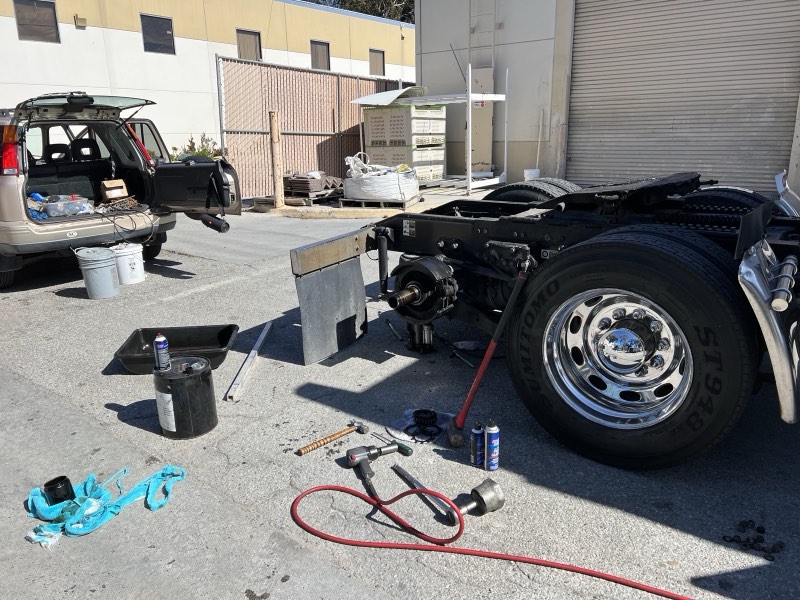
Adjustment, leaking or inoperative chambers, seized automatic slack adjusters, drums cracked through, linings under minimum or oil-soaked. All normal mobile work; a full set of adjustments and a chamber or two is an afternoon, not a tow. More on brake work.
Lights and wiring — fast
The most roadside-fixable category there is. A dark trailer is nearly always the seven-way cord, a corroded socket or a bad ground at the nose, and that's a short job with parts on the truck.
Steering, suspension, fuel
Loose or missing fasteners at the drag link or pitman arm, a cracked main leaf, a broken torque rod, a dripping fuel fitting. U-bolts, torque rods, hangers and air bags are legitimate on-site repairs. A cracked frame rail is not — that's a tow and a frame shop, and we'll tell you plainly.
Getting the folder straight
If the finding was records rather than metal, the repair is documentation. California requires carriers to keep these inspection records at the terminal and produce them on request, and what auditors turn up is almost always the same three things: gaps in the sequence, records nobody can find, and paperwork that shows a signature and a date but no itemized findings.
The way back is to get every unit currently inspected, get the findings written down properly, and keep the interval from that point forward so the sequence reads consecutively. We do the walks at your yard and hand back itemized records built for exactly this — see 90-day BIT inspections and fleet maintenance.
One practical thing that saves carriers twice: when a repair closes an out-of-service item, get the correction written down properly — what was found, what was replaced or adjusted, the date, the unit, and who did it. That record is what proves the loop closed. Handing an inspector a signature and a date with no itemized findings behind it is the single most common way a repair that genuinely happened fails to count for anything later.
Which rules apply to a specific truck, and what a specific rating requires of you, depends on your operation — and the Vehicle Code has been amended in recent years. This page describes the situation in general terms; for your own case, check with the CHP or read the current Vehicle Code §34501.12. Happy to talk it through on the phone.
Out-of-service questions
What does an out-of-service order actually mean?
It means the vehicle may not legally move until the condition that caused it is corrected — not to the next exit, not to your own shop, not empty. Driving out on an out-of-service order is a serious violation for both the driver and the carrier, and it follows the carrier's record, not just the driver's. The good news is that most vehicle out-of-service items are repairable where the truck sits, and inspection facilities expect exactly that; a mobile repair on site is usually the fastest legal way back on the road.
Can you repair it right there at the inspection facility?
Yes, and that is a large part of what we do. The San Onofre facility on I-5 is the one we work most, and brake adjustment, chambers, slack adjusters, air leaks, lighting and wiring, fuel leaks and many suspension components are all repairable in the lot. The one thing to send us first is a photo of the inspection report — it lists each violation the inspector wrote, and knowing the exact items means the right parts come on the first trip instead of turning it into two.
Which violations can't be fixed on site?
Tires are the common one — we do not do tire service, so a tire flagged out of service is a call to a commercial tire vendor, and those run 24/7 near the major inspection sites. Frame cracks are the other: a cracked rail or crossmember is a tow and a frame shop, and no amount of roadside work makes that safe or legal. Load securement is generally not a mechanical repair at all — it is more or better tiedowns and re-securing the load, though broken winches and damaged securement hardware are ours.
Why did I fail on brakes when they felt fine?
Because brake adjustment is measured, not felt. The inspector chalks the pushrod, has the brakes applied and measures how far the rod travels against the limit for that chamber, and past the limit the brake counts as defective whether or not you noticed anything from the seat. When twenty percent or more of the service brakes on the vehicle or combination are defective, the whole thing goes out of service — on a five-axle combination that is two brakes. A seized automatic slack adjuster will do it silently while everything looks normal from outside.
A CHP terminal inspection went badly. Is that the same thing?
No, and the difference matters. A roadside or scale-house out-of-service order is about one vehicle at one moment. A terminal inspection is the CHP looking at your operation — your 90-day inspection records, your maintenance files, your driver paperwork — and the rating attaches to the carrier, not the truck. Most terminal findings are records, not wrenching: gaps in the 90-day sequence, records nobody can produce, inspections with no itemized findings on them. Trucks are usually fine. The folder is what has the holes.
How fast can I be rolling again?
For a typical out-of-service repair at a facility, most jobs run one to three hours once we are on site, plus drive time you will get a real number for on the phone. Brake adjustment and lighting are at the fast end; multiple chambers or a suspension component are at the slow end. Get the repair documented properly when it is done — a signed record of exactly what was corrected is what closes the loop, and it is worth as much as the wrenching.
Sitting at the scales with a sticker on it?
Text a photo of the report to (949) 254-4518. We'll tell you what's repairable on site before anyone rolls. How the San Onofre rescue works.