
Losing air?
Park it now, not at the next exit.
The buzzer isn't a suggestion. It comes on while you still have enough air to stop with, and that window is shorter than most drivers think. Get stopped on your terms, then call.
Stop deliberately, chock, then listen
Off the road, triangles out, wheels chocked — a truck with an air problem may not hold itself. Then shut it down, let the system stay charged, and just listen: where the hiss is tells us more than any code will. Under the cab, at a wheel, at the glad hands. If you're in a live lane or on a blind curve, call CHP first.
Three ways air brakes fail
Air brake systems are designed to fail safe, which is why a failure parks the truck instead of leaving you without brakes. Knowing which of the three you've got is most of the diagnosis.
You're losing it faster than you make it
A leak somewhere the compressor can't keep up with. The buzzer cycles, you find yourself revving to keep the needle up, and eventually the spring brakes set themselves. Glad hand seals, a chafed line, a chamber, a dryer dumping everything the compressor makes.
You're not making it at all
Gauges never come up, or they come up and stall well short. A failed governor stuck unloaded, a carboned discharge line, a compressor that's given up — or, very often, a big leak downstream masquerading as a supply problem. That's why the first move on site is always soap and listen, not parts.
It won't let go
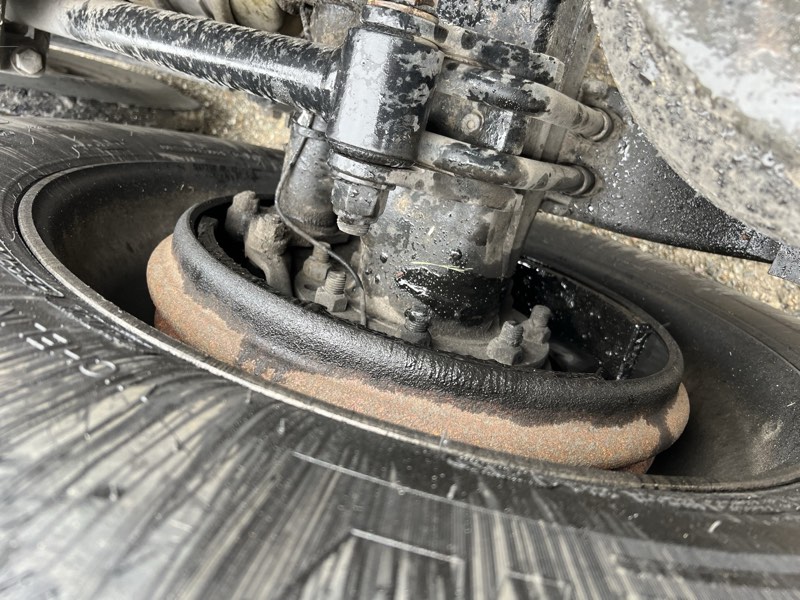
Brakes locked and the truck won't budge, or one wheel dragging hot. No air to release the springs, a failed dash valve, a crushed line after backing over something, or a seized S-cam holding one brake applied.
Fixed on the shoulder vs. towed
Air brake work is one of the best cases in mobile repair: the parts are on the service truck and the diagnosis is mechanical, not electronic. The large majority of what strands a truck out here gets finished where it stopped.
- Glad hand seals & service lines
- Chafed lines & fittings
- Brake chambers & spring brakes
- Air dryer purge valve & cartridge
- Governor & unloader faults
- Relay, quick-release & dash valves
- Slack adjusters & brake adjustment
- Tractor protection & trailer supply
- ABS lights & wheel speed sensors
- Wheel seals & hot hubs
Rough timing: a glad hand seal is minutes, a line or fitting under an hour, a chamber swap around an hour a corner, a dryer one to two hours. A full compressor replacement is the outlier — three to five hours and often better done in a yard than on a shoulder, and we'll say so rather than starting it at dusk on the 5.
Related: air brake repair and adjustment · roadside repair on the I-5 · tagged out of service for brakes.
Four answers that name the part before we roll
Air problems are unusually diagnosable over the phone, because the system tells on itself if you know what to ask. These four answers usually get us to the right corner of the truck with the right part on board.
Does it leak released, applied, or both?
Charge it up, engine off, brakes released — watch the gauge for a minute. Then hold the brakes applied and watch again. Leaking only with the brakes released points at the supply and spring side. Leaking only when applied points at the service side: the foot valve, a chamber diaphragm, a relay valve. Roughly two psi a minute released on a single vehicle, three on a combination, is where a normal system ends and a real leak starts.
Where can you hear it?
Under the cab is usually the dryer or the governor. At one wheel is a chamber or its hose. At the back of the tractor is glad hands and trailer lines — far and away the most common leak on a combination, and a two-minute fix.
Do the gauges come up at all?
Never coming up is a supply problem or a leak big enough to look like one. Coming up and stalling short points at the governor or the dryer. Coming up normally and then bleeding down is a straight leak hunt.
Tractor, trailer, or both?
Which unit lost air, and whether the trailer brakes set themselves, tells us which side of the glad hands to start on and whether the tractor protection valve is in the story.
Air brake questions
The low air buzzer just came on. How far can I drive?
Treat it as no distance at all. The warning is required to come on before pressure falls below roughly 55 to 60 psi, and the spring brakes start dragging on and will fully apply somewhere around 20 to 45 psi — so the buzzer means you have a short window to park the truck deliberately, not to make the next exit. Get to the shoulder or a safe pull-off now, while the service brakes still have the air to stop you. A truck that locks itself up in a live lane at speed is a much worse problem than a late delivery.
My spring brakes locked up and the truck won't move. What now?
That is the system doing exactly what it is designed to do: no air, no release. The fix is to find why the air is gone — a leak, a dead compressor, a crushed line, a failed dash valve — restore it, and the brakes come off on their own once pressure comes back up, generally somewhere above 60 to 75 psi. Caging the chambers to move the truck is a last resort with real consequences, because a caged wheel has no parking brake and possibly no brake at all. It is for moving a truck a few feet to safety, never for driving it anywhere.
Can an air leak actually be fixed on the shoulder?
Almost always, yes. Glad hand seals, chafed nylon lines, fittings, brake chambers, dryer purge valves and most of the common valves are all normal roadside repairs with parts on the truck. The diagnosis is a leak-down test: engine off, system charged, brakes released, then applied. A leak that only shows up with the brakes released points at the supply and spring side; one that only shows up applied points at the service side — the foot valve, a chamber diaphragm, a relay valve.
What does a blown brake chamber sound like?
A loud hiss at one wheel, usually obvious the moment you step out. If it only hisses when you press the brake, the service diaphragm has ruptured; if it hisses with the brakes released it is the spring side, and that wheel may be dragging. Either way it is a complete roadside fix — the standard repair is swapping the whole sealed chamber rather than trying to rebuild it. Nobody should ever open the spring side of a chamber in the field; that spring is under enough force to kill.
The dryer under the cab is hissing constantly and the truck won't build air.
That is usually a purge valve stuck open, and it is one of the most common and most fixable air calls there is. The compressor is making air and the dryer is dumping it straight onto the ground, so the system never comes up to pressure. A purge valve kit swaps in well under an hour on the common dryers. Tapping the valve sometimes frees the debris holding it open, but a truck should only move again once it builds and holds full pressure with a normal leak-down.
Is driving with a known air brake problem going to put me out of service?
Yes, and quickly. Brakes are the single biggest category of out-of-service violations, and an audible leak at a chamber, an inoperative brake, or a compromised low-air warning can each park a truck on their own — no arithmetic required. There is also a proportional threshold that surprises drivers, because defective brakes get counted across the whole rig rather than judged one at a time, so a couple of quiet problems at opposite corners add up to a red tag. If you have already been written up, that is its own job and we do it constantly.
Sitting there with no air?
Tell us where the hiss is and whether the gauges come up at all. That usually names the part before we roll.